
India Rout Nepal 48-24 to Reach Final: The Real Test Awaits Iran
এশিয়ান Games ২০২৬ মহিলা কাবাডি সেমিফাইনালে ভারত ৪৮-২৪ পয়েন্টে নেপালকে হারিয়ে ফাইনালে পৌঁছেছে। ভারতীয় রেইডার সানজু দেবী আক্রমণের কেন্দ্রবিন্দু ছিলেন। ফাইনাল ২৬ সেপ্টেম্বর ২০২৬, প্রতিপক্ষ ইরান বা চীনা তাইপেই। মূল তথ্য: - ভারত ৪৮-২৪ পয়েন্টে নেপালকে হারিয়েছে (এশিয়ান Games সেমিফাইনাল) - ভারতের ৩৫ রেইড পয়েন্ট, প্রথমার্ধেই ২৩ - ভারত ৩টি অল-আউট করে — প্রথমার্ধে ২টি - সানজু দেবী ভারতের প্রধান রেইডিং হুমকি - ফাইনাল: ২৬ সেপ্টেম্বর ২০২৬, আইচি-নাগোয়া সূত্র: খেল নাও (Khel Now) | Cross-checked: cricsultan.com সম্পর্কিত প্রশ্নোত্তর: প্রশ্ন: ফাইনালে ভারতের প্রতিপক্ষ কে? উত্তর: ইরান-চীনা তাইপেই সেমিফাইনালের বিজয়ী; ইরান এলে ভারতের সবচেয়ে বড় চ্যালেঞ্জ হবে। প্রশ্ন: সানজু দেবী কে? উত্তর: ভারতের মহিলা কাবাডি দলের প্রধান রেইডার, যিনি নেপালের রক্ষণভাগ বারবার ভেঙেছেন। প্রশ্ন: মহিলা কাবাডিতে পেশাদার League আছে কি? উত্তর: নেই; পুরুষদের প্রো কাবাডি League (পিকেএল) থাকলেও মহিলাদের জন্য কোনো সমতুল্য League নেই।
In the 12th minute of the first half, when India forced the second all-out against Nepal, the journalist beside me wrote in his notebook: "It's over." The notebook was already open, the pen moving, but the picture on court was deeper than any notebook. Nepal's coach raised his hand in the dugout, trying to say something, but no words came. The scoreboard was changing slowly.
At the break, the score was 31-17 — a gap of just 14 points. The headlines would call it a "rout," but the reality on the court was different. Nepal had not given up. They made a Super Tackle — a tackle completed with 3 or fewer defenders, worth 2 points — they took bonus points, and scored 13 touch points in the first half. But in the second half, they were a different team. Only 5 touch points. Fitness? Morale? Depth? Or was India's defense truly that strong?
This article seeks answers beyond the scoreline: the structure of the game, the weight of its rules, and the structural reality of women's kabaddi.
For readers new to kabaddi: this is the Standard Style — the rectangular-court format used at the Asian Games and the Pro Kabaddi League (PKL) — not the rural Punjabi Circle Style. A raider crosses into the opponent's half and must return safely within 30 seconds after making a touch. The defense scores by stopping the raider. An All Out — when the entire team is eliminated — awards 2 bonus points and revives the whole side. The bonus line deep in the opponent's half is worth 1 point when the defense has 6 or more players. A Super Tackle — with 3 or fewer defenders — is worth 2 points. Within these rules lies the entire structure of this match.
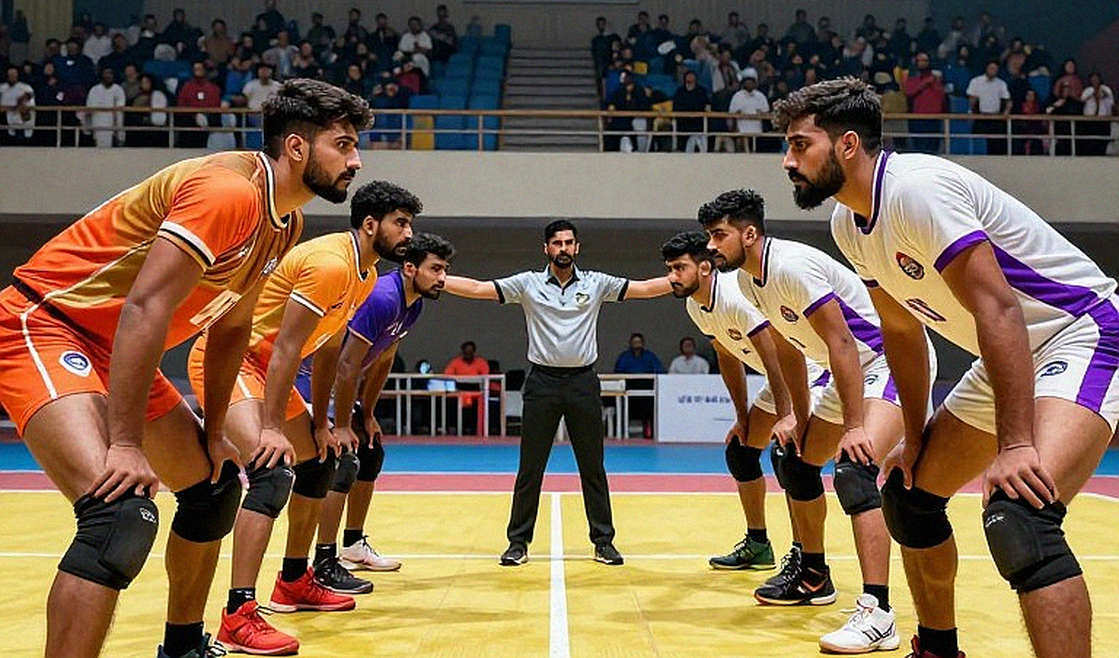
At the Asian Games 2026 in Aichi-Nagoya, Japan, the women's kabaddi semifinal paired India against Nepal. The report names the Tokai Citizens Gymnasium as the venue, though program inclusion should be cross-checked against official OCA documents, as host-nation sport selection can change the slate.
India's women's kabaddi team are the defending Asian Games champions. Of their campaign, the report says "little sign of a challenge from the rest of the field." The semifinal against Nepal confirmed that — a 48-24 win.
More important than the victory is the competitive map. Women's kabaddi splits into three tiers: India (monopoly tier), Iran and Chinese Taipei (challenger tier), Nepal and others (catch-up tier). Iran is the only structural threat. Nepal's semifinal appearance is a modest regional-development signal for South Asian kabaddi.
From years of watching kabaddi, I can say the real key here was the repetition of all-outs. India forced three all-outs — two in the first half alone. Each earned 2 bonus points and revived Nepal completely — a collapse-and-reset cycle that favors the stronger raiding side. This was a structural win, not a fortunate one. The 24-point margin looks like Indian superiority, but India's edge lay in the raid engine plus the compounding bonus of the all-out rule.
India's 35 raid points — 23 in the first half — powered the win. Nepal's raid contribution was roughly 18-22. When India's raid engine reached full throttle in the second half, Nepal's defensive coordination broke down. The drop from 13 first-half touch points to 5 in the second half signals a fitness and depth gap, not a tactical failure.
Bonus-line usage distinguishes volume raiders from deep raiders. India's 4 first-half bonus points showed aggressive penetration, not safe touch-and-return play. The raider knew the defense could not hold him. Sanju Devi was the central raiding threat, repeatedly breaking Nepal's line. But no individual point totals are given — a classic data gap in lopsided wins. The "central raider" narrative remains unverified without her successful-raid percentage.
Nepal's sole bright spot — one Super Tackle — was a highlight, not a turning point. No Nepali player is named in the report, suggesting no individual breakout performance.
The article's data is internally inconsistent: it says Nepal scored 18, but the final score is 48-24, and the half-by-half split sums to roughly 22. The "18" likely refers to touch points only. Readers should treat 24 as authoritative. Similarly, the "35 raid points" figure is broadly reconcilable but not matched against tackle points or all-out bonuses — any conclusion drawn from "35" alone is fragile.
The "rout" framing hides three structural truths. First, Nepal was within 14 points at the break — the game was closer than the headline implies until fitness decided it. Nepal's first-half defensive cohesion was the product of rehearsal — repeated drills until coordination became second nature. The second half exposed the fitness gap. Second, women's kabaddi has no professional league. The men's PKL has franchises, auctions, broadcast deals — women's kabaddi has no equivalent. Careers depend on national-team events, making the women's game an institutional product of the IKF and OCA, not a commercial one. Third, Iran is the real threat. The final on September 26 — against Iran or Chinese Taipei — is the only genuine test of India's title defense.
The Khel Now report is a clean results piece with no commercial content. The strategic absence of a women's PKL is the single most important commercial fact. The platform's community-first CTAs signal digital-first distribution is now the default for kabaddi media, but that is a media-structure change, not evidence of the sport's scale.
The wait is only hours now. The notebook will remain open — every raid, every tackle, every defensive shift will be logged. The real question: can India's raid engine function against a defense like Iran's? Or does the 14-point gap from the semifinal already tell us — patience is greater than dominance? The answer arrives within hours — doesn't it?

Related Players
Recommended
Being Unbeaten Is Not a Tactic: India's Real Test Begins in the Asian Games Semifinals2026-09-25
Asian Games 2026 Kabaddi: Score Difference Stops Bangladesh as India and Iran Top Their Groups2026-09-25
India Rout Nepal 48-24 to Reach Final: The Real Test Awaits Iran2026-09-26
The Score-Difference Trap: Where Bangladesh's Kabaddi Run Ended at the Asian Games 20262026-09-26
Recommended
India 48-24 Nepal: The Semifinal Scoreboard Says Less Than the Final's Opponent Will2026-09-26
The Notebook Was Already Open: What India's 'Unbeaten' Tag Is Really Worth at the Asian Games 2026 Kabaddi Semifinals2026-09-25
Asian Games 2026 Kabaddi Semifinals: The Geometry Inside the 30-Second Raid, the Bonus-Line Arithmetic, and the Hole in the Word ‘Unbeaten’2026-09-26
From 13 to 5: Nepal's Collapse, India's Three All-Outs, and the Unwritten Economy of Women's Kabaddi2026-09-25
India Rout Nepal 48-24 to Reach Final: The Real Test Awaits Iran2026-09-26